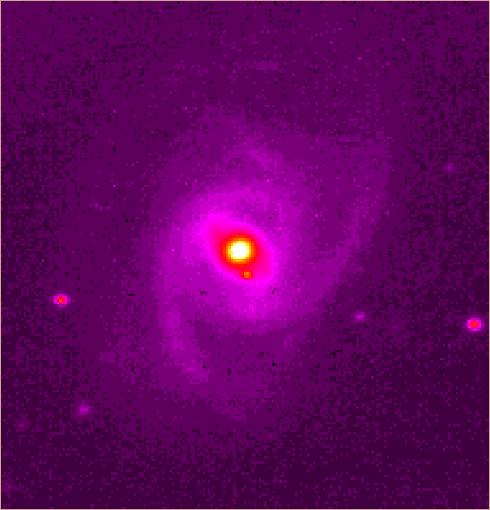
A sample of 45 face-on spiral galaxies has been imaged in the near-infrared
K-band (2.2 microns),
to determine the morphology of the old stellar population, which dominates the
mass in the disk, in order to test theories of spiral structure.
The above image shows one of these galaxies, UGC 3900,
imaged in the K-band. Parameters have been calculated which describe
the bulge, disk
and bar K-band light distributions, and correlations showing the interrelation
between these components have been investigated.
It has been found that bulge profiles are not well-fitted by the classic de
Vaucouleurs (1953) profile, and that exponential or
R1/2 fits are preferred.
Bulge-to-disk ratio correlates only weakly with Hubble type. Many of the
galaxies show central reddening of their J-K colours, which is interpreted as
due to nuclear starbursts or dusty AGN. This will be followed up in more
detail at a leter date.
A new parameter for measuring the strength of bars and arms is defined,
which is called Equivalent Angle. This is better than the traditional
arm-interarm contrast, as it is not subject to seeing and resolution effects.
Bars are found in 40 galaxies, 9 of which had been previously classified as
unbarred. Bar strengths are found not to correlate with disk surface
brightness or the presence of near neighbours, but a tendency is found for the
most strongly barred galaxies to lie within a restricted, intermediate range of
B/D. Bar light profiles are found to be either flat or exponentially
decreasing along their long axes, with profile type not correlating strongly
with Hubble type. Bar short axis profiles are significantly asymmetric, with
the steeper profile being generally on the leading edge, assuming trailing
arms. Bars are found with much higher axial ratios than have been found in
optical studies.
This dataset has also been used to test theories of spiral structure. The
K-band images of the spiral galaxies have been used to calculate different
characteristics of the underlying density perturbation such as arm strengths,
arm profiles and cross-sections, and spiral pitch angles. The combination of
these results seems inconsistent with predictions from the simplest density
wave theories. Bars do not have a measurable effect on the strength or profiles
of arms.
B-band images of three of these galaxies have been obtained. For these B-band
galaxy images arm cross-sections and strengths have been investigated, so as
to determine the effects of mass perturbations on star formation in spiral
disks. It is found that B-band arms lead K-band arms and are narrower than
K-band arms, apparently supporting predictions made by the large scale shock
scenario, although the effects of dust on B-band images may contribute towards
these effects.
If you would like a compressed postscript copy of my PhD thesis click here
Last updated April 8 1999
 ([email protected]) for any suggestions